Covent Garden (2018)
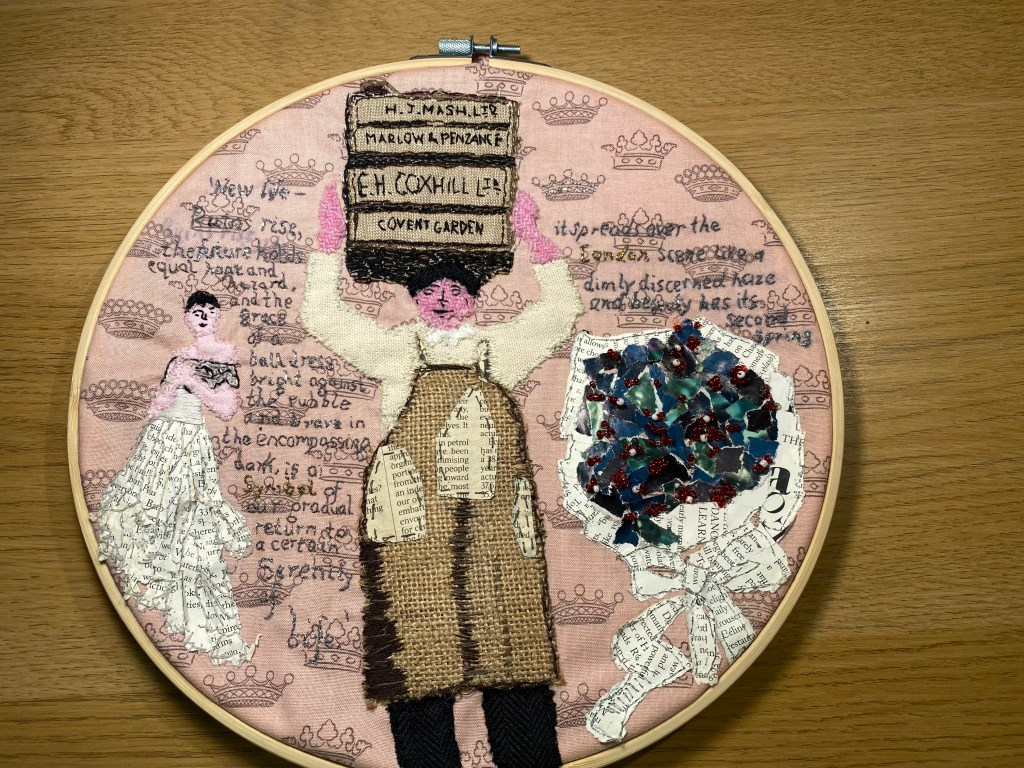
This circular embroidery was inspired by the transformation of Covent Garden — from working market to the grandeur associated with the Royal Opera House and its surrounding redevelopment.
The piece contrasts past and present through material, texture and stitch.
At the centre, a market figure lifts a crate bearing historic shipping marks — H.J. Mash Ltd, Marlow & Penzance, E.H. Coxhill Ltd, Covent Garden — hand embroidered using back stitch and split stitch to retain the irregularity of hand-painted signage. The lettering is intentionally uneven, echoing the functional aesthetic of trade and labour.
The figure’s apron is constructed from coarse hessian, appliquéd and secured with blanket stitch and whip stitch, its rough weave left visible. In contrast, the adjacent floral form — representing cultivated elegance and curated beauty — is built from torn printed paper, layered appliqué and dense clusters of seed beads stitched individually to create surface shimmer and depth.
The pink ground fabric — printed with crown motifs and overlaid with hand-written text — references institutional authority and historical narrative. The script, stitched and drawn across the surface, suggests shifting histories layered over one another.
This piece explores tension:
- Labour and spectacle
- Utility and ornament
- Market and monarchy
- Craft and commerce
Open Call Collaboration –Here Comes the Sun – 2020
I responded to an open call by socially engaged artist Lois Blackburn, which led to my inclusion in the collaborative quilt project Where is the Sun.
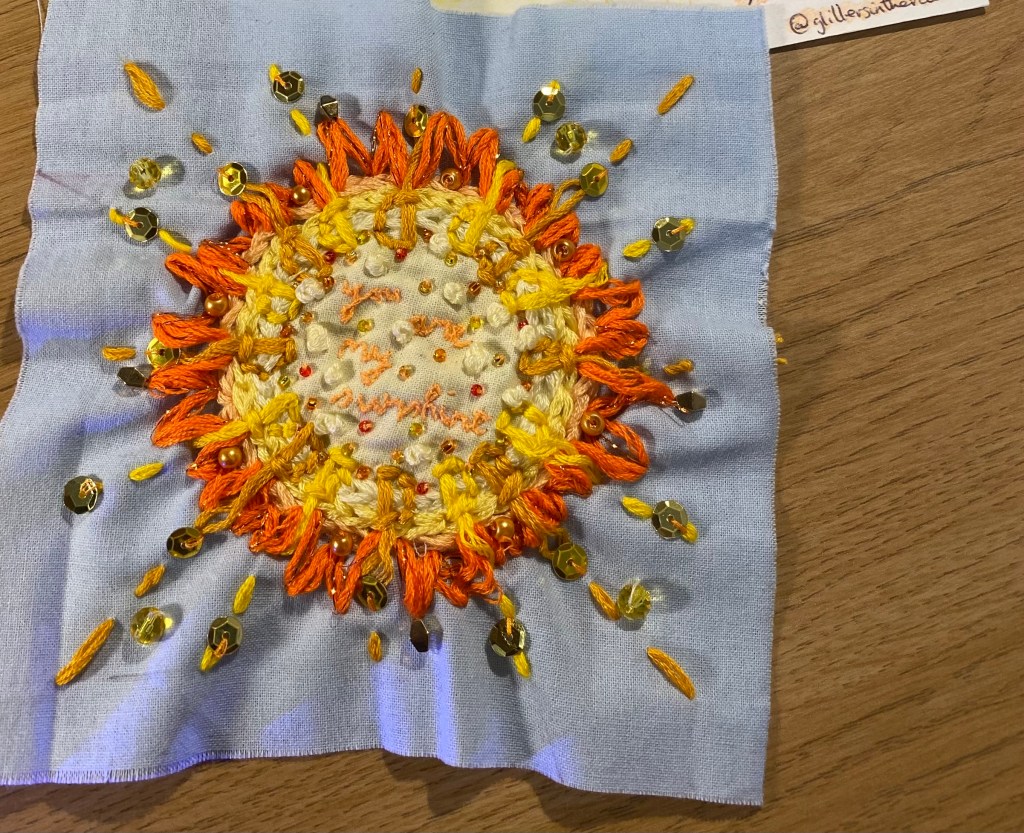
My contribution centred on the sun as both symbol and presence. Constructed through layered stitch in graduated yellows and oranges, the form radiates outward from a pale, textured centre embroidered with the words “You are my sunshine.”
The surface is deliberately dimensional — thick threads, looping stitch and applied sequins catch and reflect light. Gold elements extend beyond the circular form, suggesting warmth that travels outward beyond its boundaries.
My background in lighting inevitably informs the work; the added reflective surfaces allow the textile to respond dynamically to illumination, shifting subtly as light changes across it.
Witches in Politics (2020)
In 2020 I responded to an open call by artists Anna FC Smith and Helen Mather for Witches in Politics, a project reflecting on power, protest and historical memory in response to the Peterloo Massacre.
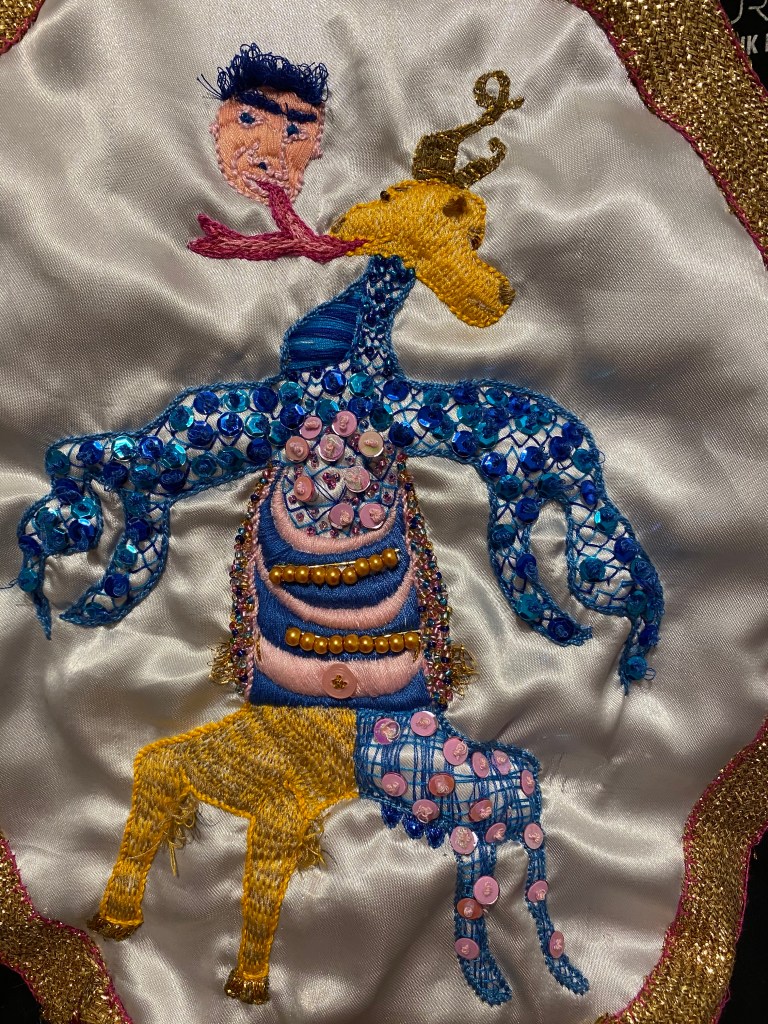
The brief invited artists to embroider children’s depictions of “monsters” onto T-shirts — reframing ideas of fear, authority and threat through textile intervention.
My piece developed a hybrid figure: part human, part animal, part ceremonial costume. The body is constructed through dense stitch, layered mesh, sequins, beads and metallic thread. Blue netting overlays the arms; pink buttons and gold beads form armour-like decoration; sections of the body feel both vulnerable and protected.By translating a child’s drawing into labour-intensive stitch, I was interested in:
- Who defines a “monster”
- How power is disguised or embellished
- The tension between ornament and threat
- The way spectacle can distract from violence
The use of reflective sequins and beadwork allows the surface to shift under light — at once playful and confrontational. As with much of my work, illumination changes the reading of the piece, revealing and concealing detail depending on angle and intensity.
New Mills Art Trail (2021)
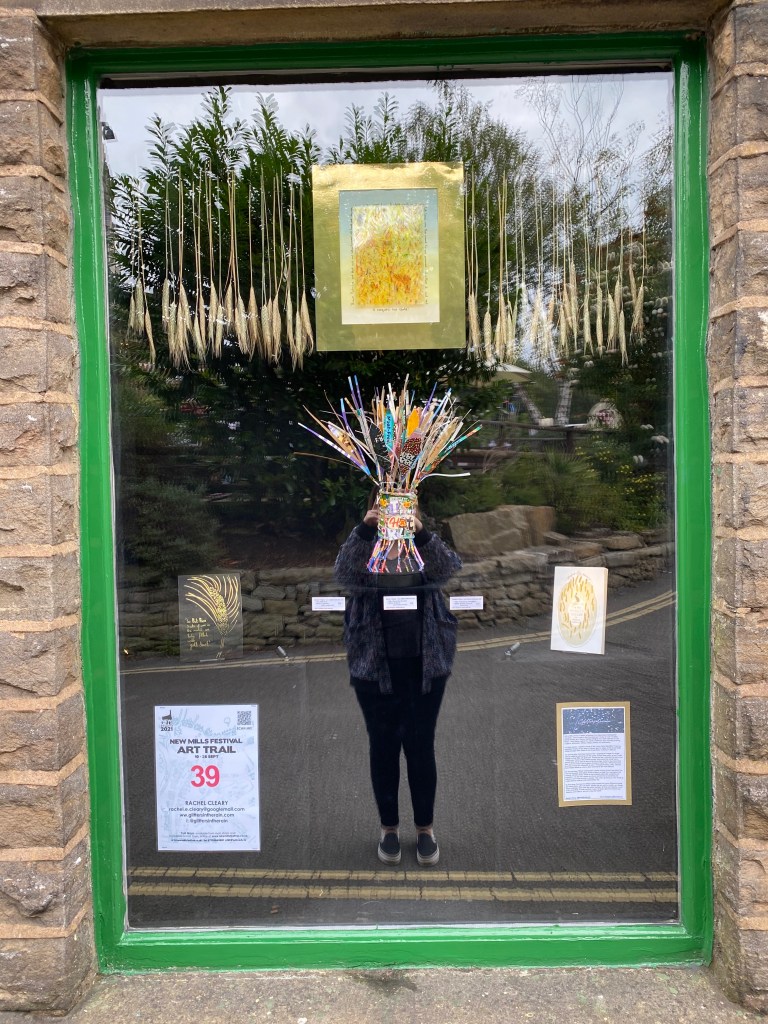
For the New Mills Art Trail 2021, I created a window installation responding to wheat as both a historical trade commodity and a contemporary everyday staple. The project was inspired by a local community initiative to grow and harvest wheat collectively, reconnecting people with agricultural processes often hidden within modern supply chains.
The central sculptural form was constructed entirely from recycled packaging — all of which had once contained products made with wheat. Cereal boxes, flour bags and food packaging were dismantled, cut, layered and structurally bound using thread. By repurposing these discarded materials, the work traced wheat’s journey from field to factory to supermarket shelf.
The vessel-like structure referenced storage, containment and trade — echoing grain sacks, shipping crates and market exchange.
Suspended dried wheat stems framed the installation, forming a threshold between street and interior. Their vertical repetition created a rhythm across the window, delicate yet architectural. In daylight, reflections merged the work with contemporary life; at night, carefully positioned lighting transformed the window into a glowing reliquary.
The installation explored:
- Commodity and consumption
- The invisibility of labour
- Cycles of growth and manufacture
- The tension between natural material and industrial process
British Textile Biennial – Blackburn Cathedral – 2021
I was selected to exhibit as part of the British Textile Biennial, showing work inside Blackburn Cathedral in collaboration with Mr X Stitch.
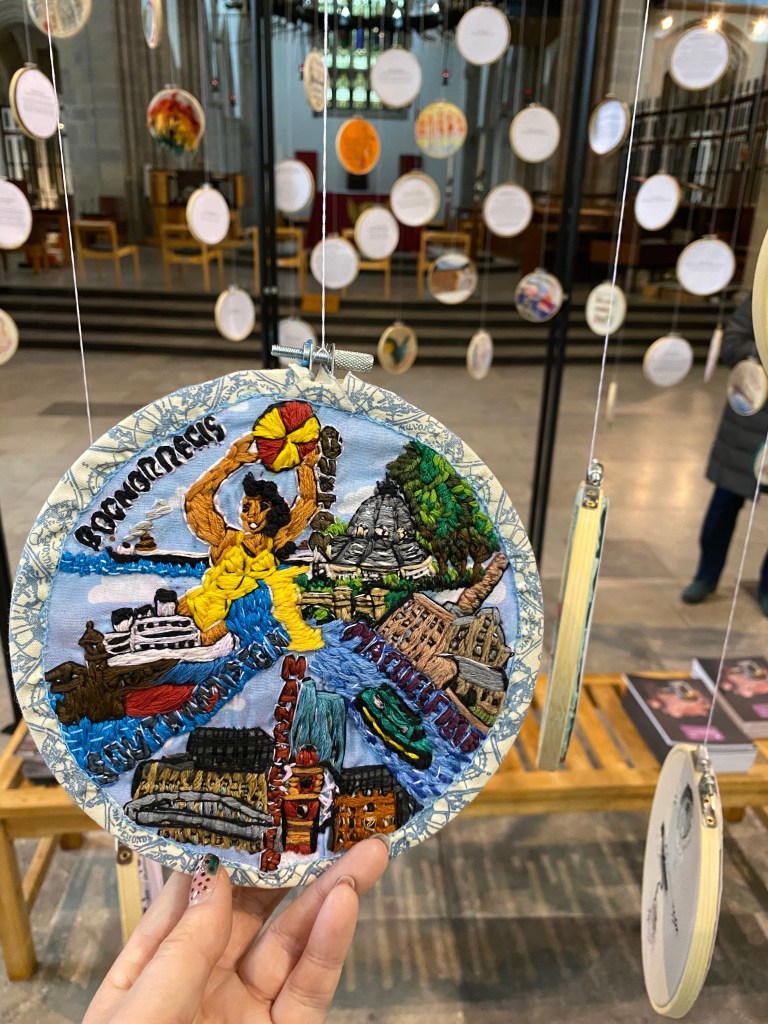
The embroidered piece responded to the theme of migration through a personal lens — mapping the different places I have lived in the UK.
Inspired by vintage railway poster imagery, the work adopts bold colour, strong compositional lines and stylised landmarks. Locations radiate from the centre like destinations on a rail map, connected by waterways and transport routes. Architecture, landscape and industry sit side by side — each rendered in dense, saturated stitch.Rather than focusing on displacement, the piece celebrates accumulation — how living in multiple locations builds layers of belonging. Thread becomes the connective line between towns, cities and memory.
Displayed within the cathedral, suspended among many other embroidered discs, the work became part of a collective field of stories — individual journeys stitched into a shared space.
Comfort (2023)
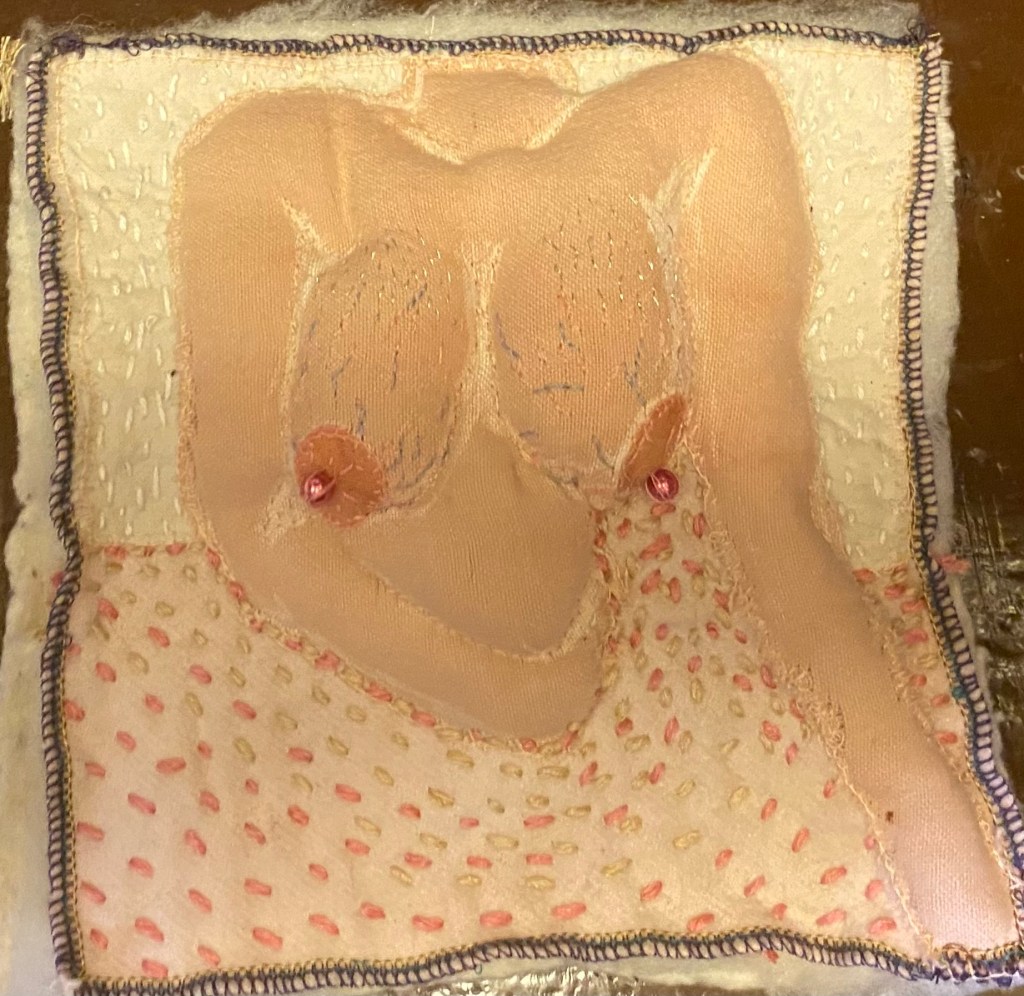
Created for Comfort, a collaborative quilt led by Lois Blackburn, this embroidered square forms part of a national project exploring experiences of breasts across different ages and identities. Through workshops and shared making, the quilt examined themes including puberty, ageing, body image, sexualisation, illness, surgery, breastfeeding and gender identity — creating space for conversation around subjects often considered private or taboo.
My square responds to ideas of embodiment and presence. Using layered appliqué and stumpwork, I introduced raised forms so the body sits forward from the surface rather than remaining flat or decorative. The dimensionality allows light to define contour and shadow, reinforcing the physicality of the form.
Repetitive hand stitching grounds the piece in a slower, reflective process of making. Within the wider quilt, the work contributes to a collective exploration of visibility, care and bodily autonomy.
 RACHEL E CLEARY LIGHTING DESIGN